

Apple Marketing Strategy Genius
Apple is a marketing genius, but that isn't evident unless we look under the hood to uncover how their marketing saved one of the most difficult times in the industry.

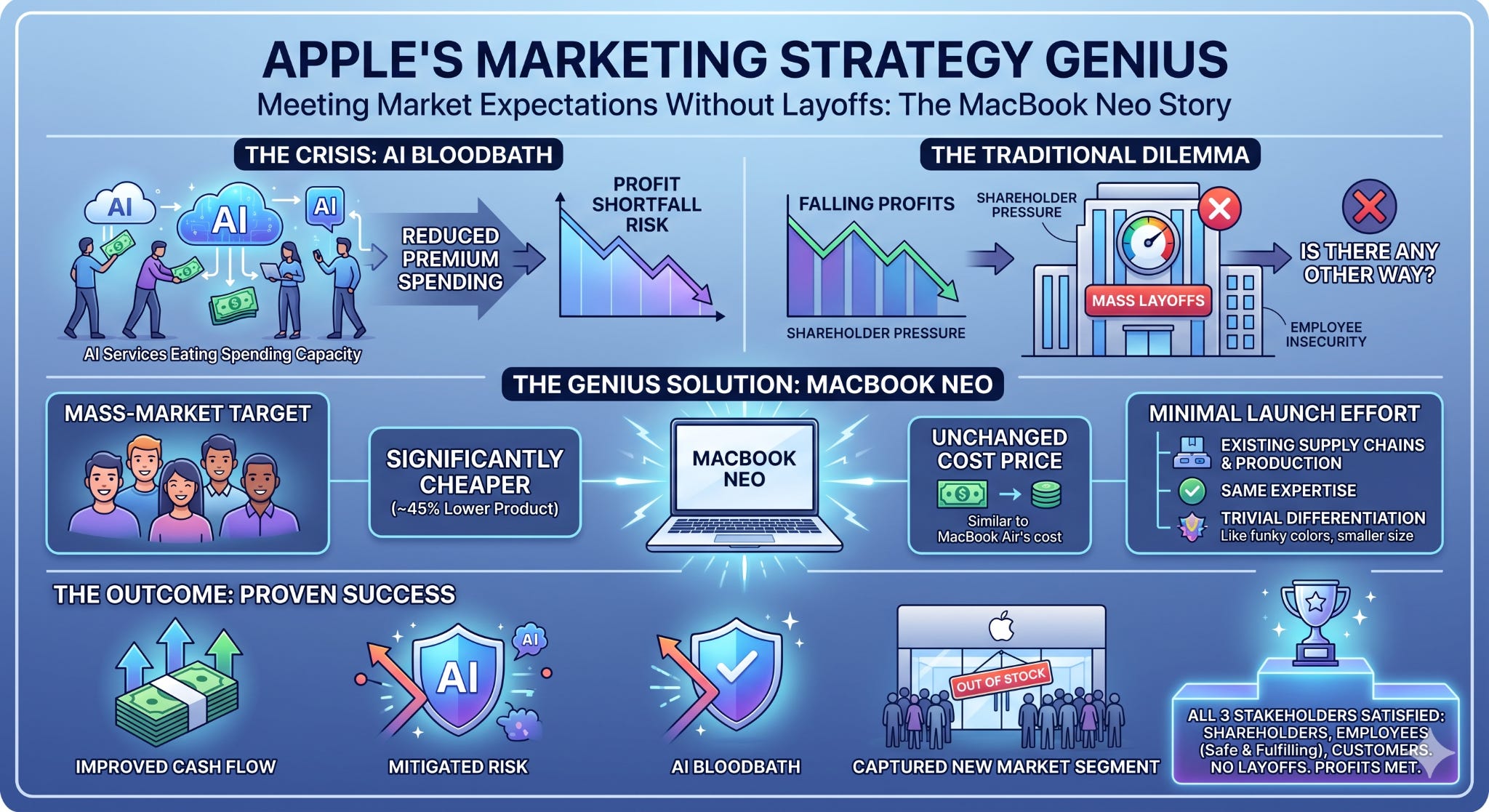
How Apple tapped into its marketing genius to meet the capital market expectations when the AI bloodbath birthed a new category of products, eating into the spending capacity of its primary premium market segment, while ensuring its employees don’t feel insecure because the entire industry was on a firing spree, proving they are masters when it comes to strategy.
Before we get into what Apple did, it would be worth identifying what constitutes a good strategy because this is what we measure Apple’s strategy against. A good strategy is one which meets the following conditions:-
It generates profits now, as well as in the future, satisfying the needs of its shareholders.
It offers a safe and fulfilling work environment for its employees now, as well as in the future, satisfying their needs.
It meets the needs of the market now, as well as in the future, satisfying its customers.
It is also worth noting that if a strategy is truly great, then any change outside its control shouldn’t affect the company in any way. E.g., if the market goes down, then also, the company shouldn’t (a) fall short on projected profits, (b) need to lay off employees, or (c) miss out on addressing the present needs of the market.
An argument arises in the event of external, uncontrollable, poor market conditions; in such challenging times, profits decline because they affect the purchasing power of the target customer segment. As a result, the company falls short of its financial projections. To meet the public market financial projections, the company must make cuts somewhere in the business. The cuts usually happen in the largest cost centres, i.e., payroll, resulting in layoffs. With that prevailing logic, the argument is, “Is it even possible to tackle external market pressures without exercising internal cost-cutting measures like layoffs?” Most senior executives’ response to that question is unquestionably “No”.
However, there is a way to spare the company the trauma of mass layoffs while ensuring its profits meet public market expectations.
Let’s understand a few things before we move forward. Often, a small change in the product offering is enough to satisfy a new customer segment. So, if a new product can be launched without significant investment or team effort and capture a new market segment, it could offset the loss of share in the existing market segment.
Unchanged Cost Price
MacBook Neo is a mass-market product priced lower, but its cost price is somewhat similar to that of MacBook Air. This means the MacBook Neo’s per-unit gross profit is much lower than that of the MacBook Air.
Low Efforts to Launch
The overall effort required to launch the MacBook Neo was close to an order of magnitude less than that required to launch the MacBook Air. Internally, the teams and expertise are the same as those of the MacBook Air. Externally, the same supply chains and production lines are utilised with minimal to no change.
Low Selling Price impacts product margins
If a previously unaddressed customer segment could be captured by reducing the product selling price, it would reduce product margins.
Outcome: Improved Cashflow
If one takes into account the largely unchanged cost price, low launch effort, and lower selling price, this results in the capture of a new market segment. Essentially, since there are no launch efforts, the company could offer the product at a lower selling price while maintaining its gross margins, improving overall cash flow.
Back to the impossible claim of meeting both requirements of not laying off people and ensuring predicted profits are met in poor market conditions. At this point, to make up for the losses from the current target customer segment, Apple decides to launch MacBook Neo with barely any extra effort, and a low price point targeted towards a previously unaddressed customer segment - mass market - a strategy previously unexercised by Apple. This new product line is aimed at offsetting losses from the struggling existing target customer segment.
Here, the poor market conditions are driven by the AI Gold rush. Apple’s existing customers are spending money on AI services and products, and hence buying less from Apple, or at least, less frequently, at best, resulting in Apple’s profits going down. To meet financial market expectations, the Apple finance team would suggest cutting costs. And what is it that is never harshly reacted to by markets - laying off people? Hence, the axe generally falls on the employees.
However, in this case, that didn’t happen; Apple came up with a genius marketing strategy tactic they’ve been saving for a rainy day. The answer was MacBook Neo, and it’s a masterclass in product marketing strategy, cleverly exploiting market segmentation methodology.
The MacBook Neo launch means
A cheaper (~45% lower) product is opening the door to mass-market customers. More cash in hand.
Apple successfully mitigates the new risk introduced by AI Rush towards the existing customer segment.
A swift, core-red response that is light on the books and blazingly fast to market. This meant Apple could address the market bloodbath caused by AI in time.
All that was required by the marketing team was to tweak the product positioning of MacBook Air to be more attractive to the new customer segment - the mass market.
It first dawned on me when an Apple Genius told me, “Sir, this product is meant for the students who are looking for cost-effective products.” And I couldn’t stop thinking about it for days because, for as long as I have known Apple, the company has been a nightmare for the mass-market segment with its notoriously premium pricing strategy.
The results are in, and markets have again rewarded Apple. MacBook Neo is the first product after the iPhone to go out of stock for an extended period. Generally, if an Apple product goes out of stock, it’s a bittersweet feeling internally because it means they have outperformed their own internal sales targets. Eventually, it means they’ve succeeded in avoiding the AI Bloodbath, at least for now. If it hadn’t succeeded, the only 2 options would have been to report lower profits or to lay off people. The Apple leadership would’ve hated both options because they violate the first and second rules of a good strategy.
MacBook Neo is a masterclass in market segmentation by Apple.
Apple wins again, proving that their strategy is truly a great strategy, and all 3 stakeholders - shareholders, employees, and customers are satisfied for now.