

India’s Drone Conundrum
India wants to become a Global Drone Hub by 2030. In this post, I cover what it takes to get there and the biggest current bottleneck to achieving it.

Disclaimer: I am a volunteer at iSpirt; this post is based on my work there.
India wants to become a Global Drone Hub by 2030. At least, that’s the PM's wish. That means the country making strides on economic and sovereign fronts. Economic: Optimise last-mile delivery; Sovereign: Secure India on the security and safety fronts.
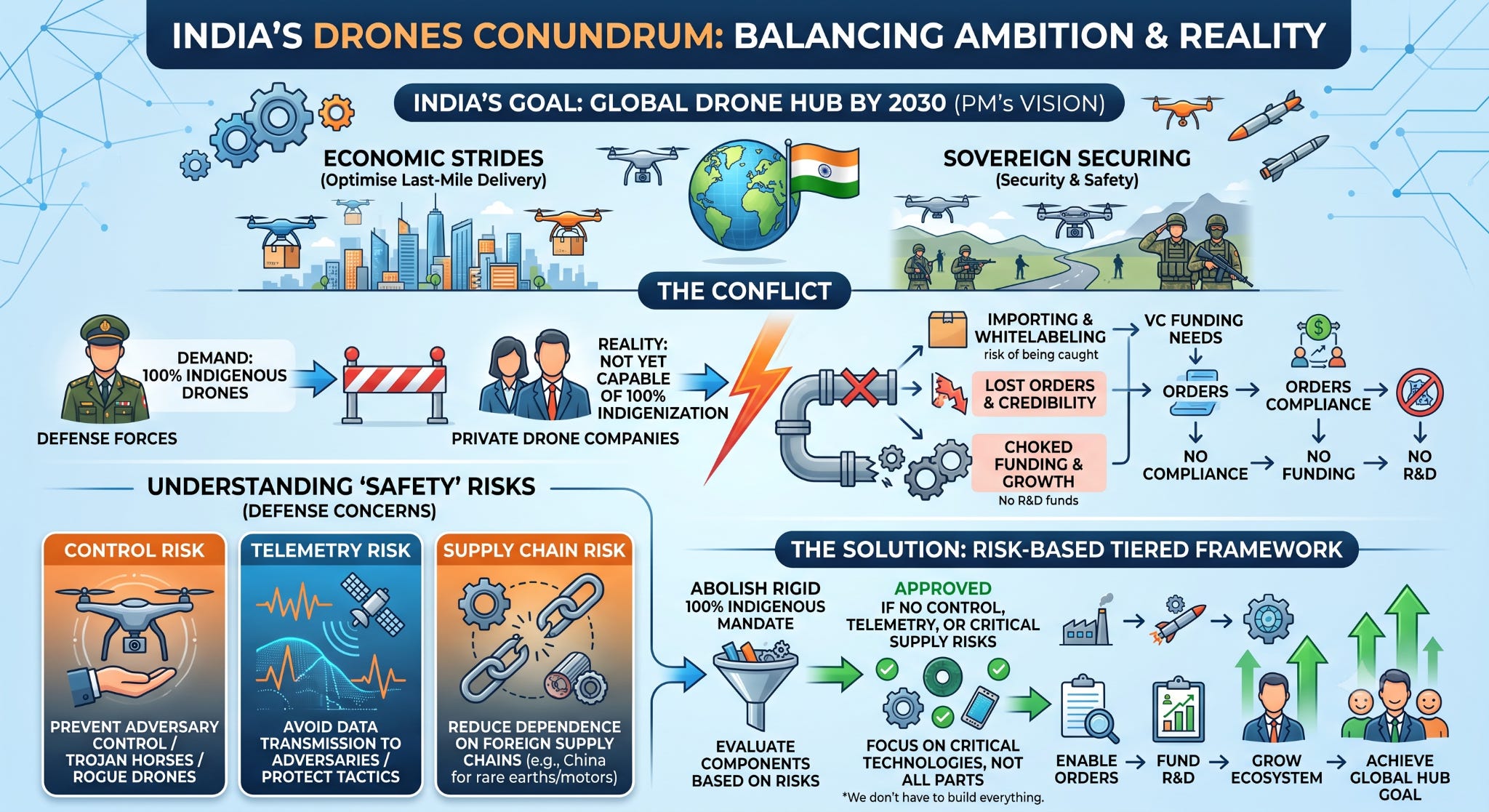
For the drone ecosystem to jump-start, defence is a major potential customer, driven by the sudden limelight that Drones have gotten amid the Russia-Ukraine and US-Iran conflicts. Hence, it’s only fair to conclude that defence spending would pave the way for the economic engine to follow suit. In this post, I argue that defence is itself strangling the private drone ecosystem from taking off.
The current landscape in which the Indian defence forces and private players operate has reached a point of conflict, hindering private players from achieving 100% indigenisation and preventing defence players from procuring advanced drone technology they can truly rely on.
The Indian Defence has overambitiously and unrealistically mandated that 100% of drone components be indigenous as a necessary condition for awarding orders. At present, the private players are nowhere near that. So what are the private players doing? They are either importing, whitelabelling, getting caught, and losing credibility and orders, or the defence isn’t meeting its procurement needs.
If 100% indigenisation were to become reality, it would only be possible with a sufficient capital injection from private players into R&D. For that to happen, the private players must secure enough orders to fund their R&D. The VC ecosystem can’t sufficiently drive these high R&D efforts when the private players are failing to secure orders from their biggest customer - the Defence forces.
So what is the solution? Before getting into the solution, let’s question an assumption the Defence forces made: that only a 100% indigenous drone is safe for them to operate.
What does safe mean in this context? It means avoiding the following risks:-
Control Risk: The drone must always be under the control of the defence forces and never be controlled by a foreign adversary, act as a Trojan horse, or go rogue.
Telemetry Risk: It must never transmit any data to a foreign adversary, giving them intelligence on our military tactics.
Supply Chain Risk: Dependence on a foreign supply chain jeopardises production consistency if the adversary is the sole controller of the key component. E.g., China controls almost all supply chains, including those for rare-earth magnets that power BLDC motors that fly most drones.
This raises the question: if a component and its subcomponents don’t violate these 3 necessary conditions (risks), should we be left outside the 100% indigenisation purview?
The answer is yes. In short, we don’t have to build everything. The problem lies with Indian Defence procurement asking for something that’s impossible to attain at the current time. And thus, if a drone manufacturer doesn’t meet that stringent 100% indigenous mark, they don’t get the order, choking procurement and strangling the early-stage Indian drone ecosystem players.
The solution, in my view, is that the defence must abolish its blind 100% indigenous components criteria for awarding orders and adopt a tiered, risk-based framework that allows the use of components that fall outside the high-risk band. It wouldn’t be easy, but it is exactly the boost the ecosystem needs if flight for India’s dream of becoming a drone hub has to take off.